
Surgical Cancer Care
Surgery is one of the three main types of treatment for cancer, in addition to medical oncology and radiation oncology. At Stony Brook Cancer Center, our board-certified surgeons specialize in treating a group of related cancers. They collaborate with the medical oncologists and radiation oncologists on their team to create a personalized plan of care for an individual’s unique needs.
Main Reasons for Surgery
- Find out if it is cancer: Surgical removal of part of the tumor or tissue, so it can be viewed under a microscope to determine if it’s cancer. Referred to as diagnostic.
- Remove the cancer: Surgery to take out the entire cancer. In certain types of cancer, when the tumor and the surrounding tissue is removed and it has not spread to anywhere else in the body, the patient is considered cured. Referred to as surgical resection.
- Remove the most cancer possible: For different reasons, only part of a cancerous tumor cannot be taken out. The remaining cancer may be able to be treated with chemotherapy or radiation. This can help extend the patient’s lifespan. Referred to as debulking surgery or cytoreductive surgery.
- Restore the body’s form and function: Surgical procedures are performed to repair or rebuild a part of the body that has been affected by cancer or its treatment. This can include bringing back function, improving appearance, and helping regain confidence. Referred to as reconstructive surgeries.
- Improve quality of life: When a cure for cancer is not possible, surgical procedures can help manage symptoms like pain, bleeding, and other complications caused by the cancer. Referred to as palliative surgery.
Main Types of Surgery for Cancer
Traditional or “Open” Surgery
Traditional surgery is often called open surgery. It usually involves a single incision (cut) that is large enough so that your surgeon can operate with a scalpel in their hands.
Why your surgeon would recommend open surgery:
- The tissue that needs to be removed will not come out without a larger incision.
- If you have had many other abdominal surgeries and scar tissue is expected.
- If the cancer has spread (metastasized) beyond the original site to other organs, open surgery may be the most efficient way to remove the tumor or tumors and other organs at the same time.
Laparoscopy
During a laparoscopy your surgeon uses a thin, lighted tube with a video camera at its tip. This tool is called a laparoscope. Multiple small holes are made in the abdominal wall to insert a camera and instruments into the abdomen. Once the goals of the operation are accomplished, a small incision is made to remove the tissue of concern.
Robotic-Assisted Surgery
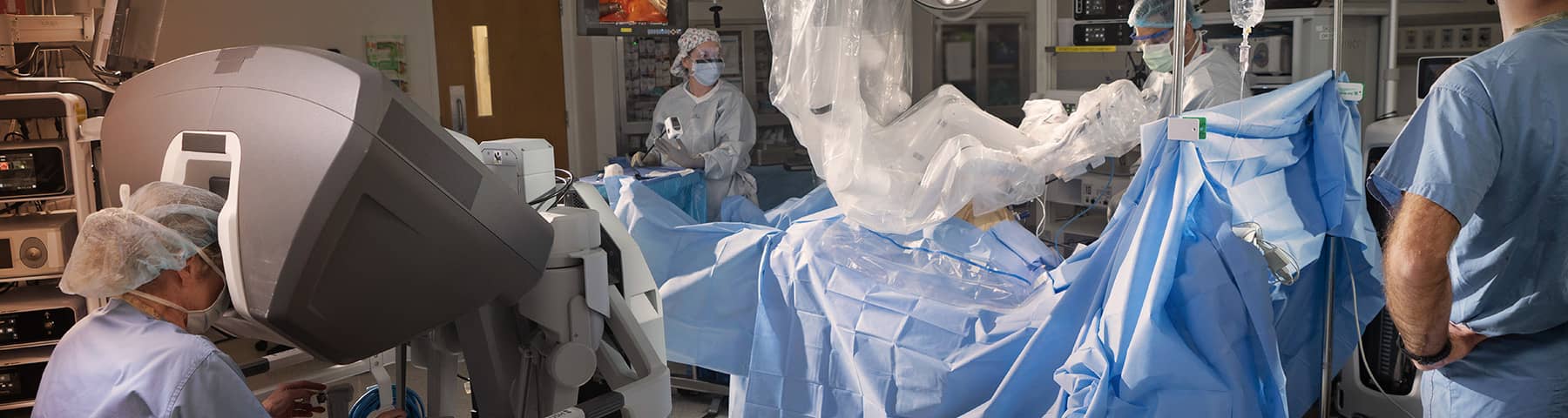
In robotic-assisted surgery, a camera and instruments are inserted through keyhole-size cuts in the body. Then, robotic arms are attached to the instruments and your surgeon sits at a computer and uses controls to move the robotic arms. A high-definition visual system helps your surgeon see more clearly by magnifying the operation.
Why your surgeon would recommend one of these minimally invasive procedures:
- Surgeons can use smaller incisions than in open surgery.
- These techniques can help minimize damage to nearby organs and tissues.
- A lower risk of infection and less blood loss.
- Patients often recover faster.
Learn More About Your Surgery
To find out which type of surgery may recommended, click on your cancer type here.
Is there a clinical trial right for you?
